 AR
AR DE
DE ES
ES FR
FR IT
IT JA
JA NL
NL PL
PL PT
PT RU
RU CN
CN
This may be interesting to some; appropriate given the circumstances; I’m without any social network.
Not easy to do this. I find myself asked to sketch out my background because someone else sees the value (that I don’t). So, here goes.
“Where you have been? What have you been up to?”
I hesitate; for some reason I realise that a map is unrealistic, because of weather. I’m thinking about nights in storms on a lee shore in Norway (age 19) then railway stations in the rain. . . .then Jakarta with lightning, then Finland in winter walking back from work on an Icebreaker (a ship). The Gydnia (or was it Gdansk?) shipyard in the dark, snow and ice during a famine. What about that day we arrived in Turkey to commission a ship, driving through the ruins of the earthquake? That was sunny.
Then I’m in recall at the peak of a mountain in Oman, quiet, being served a coffee by a young mother who can’t believe anyone stopped by. Pin-drop silence. A broken thermos flask in the traditional Omani shape with her baby oblivious to the circumstances; we offer a gift, our brand new thermos of identical form which is considered appropriate and acceptable. A kind jest by her to imply “I won’t say no”. I needed to know that the offer was else than insensitive and she, in her solitude, picked that up and (without words) let me know that it was quite alright.
Then I’m 19 again, remembering Hong Kong, on the deck of a Royal Navy patrol boat, picking up Vietnamese refugees and sinking their abandoned boats. Can’t take those along, can’t leave obstacles behind in the night. I’m looking at him, a teenager, safely on deck in shorts, holding an orange. It’s warm, so it’s alright. I notice he’s healthier than me, but I’m too young to. . . .deduce anything about it. You may know occasions where you exchange views eye to eye and we do, there, then, and it’s quite alright, from his point of view. Me too; three seconds is not much. I hope you’re reading here now.
Then I’m thinking of how it turned out for a young couple doing a yacht charter in the Red Sea. They describe to me how they and their guests are arrested in Somalia, the yacht is impounded and they’re escorted as prisoners inland with drunk or drugged police escort. Someone (a sheep farmer and his wife) find out about their situation using radio and light aircraft; ambassadors protest; they know nothing of what’s going on; marched back to the coast, back to the beach where the soldiers turn their rifles on the sergeant and he’s executed right in front of them. Now we’re in Southampton, the couple are preparing the yacht again and I’m wiring up something; I don’t remember what, but necessary according to them. . .
They’re part of my past, all of them, brushing my mind with theirs. One taxi driver; I feel it and just before arriving I add quietly “If someone murdered me. . . .I’d just feel disappointed”. Enough said, I pay, descend (apologies, french off, I get out of the taxi) and continue the journey. Yet, why did I just listen as the technician driving us to work boasted that he’d killed not one, rather two boys on mopeds on just that particular roundabout, using his supposed right of way to accelerate and “get them”. Same routine the next year. . . . . . . . and he’s complaining now that he doesn’t know why his wife divorced him.
“Jesus Christ! I need it to read it!” “Is the rest going to be like this?!”
I have a slight feeling like I’m going to throw up – too much coffee this morning, where I am now, in the south of France. Not very pretty; what framers and gossipers do here. Framers, not farmers! I think it was, um, what was the name again, Tom Sawyer – no, wait, Mark Twain – who wrote that he was here, was amazed by the beauty and unimpressed by the “lack of principles”. Was he here? If so, it seems he didn’t really stick around to find out more. Didn’t use his real name either. Although I nearly died of defamation (and a collision with a deer) I got back up and carry on – receiving very much, very kind help. About much else too. Why is it that people an-alphabet, who can neither read nor write. . . . .always did right, did the best, like everything’s a breeze? I’ll work that out later; I can’t really know, unless I become like them. My elder sister is now paraplegic, but it’s not the same. . . .
Throughout (much), babies and toddlers amaze me. People who know me best, with a kind word to say, remark that my (foremost) passions are toddlers and engineering. Before some say “Great! Here are mine and the broken down Chevy’s over there!”; I have my hands full right now as you may have gathered. If it’s local and in favour of service. . . .well, I do install irrigation systems, repair Quads, change out motors on. . . . .what’s the English again. . . . .um, electrified sun. . . .something. Aluminium blinds that roll down and when they’re stuck. . . . you are too. Small stuff, like wiring stables with LED lighting, one 10W lamp per horse, yet really, the horse is magnificent, not I. Musicians astound me. I listen to “Pretty Lights” to work and to work out. Every contribution Derek! All of it; every nuance. I hope you get it; reconciliation please.
Overall, to bear in mind, resolving Cancer isn’t the only thing that I do.
“Jesus Christ! There he goes again!” Well; it’s all very motivating. “Might be to you buddy! That’s what you call an opinion!”
So it is; which is alright here, because it’s else than engineering, else than scientific. “Uh oh! Now you’re going to get boring.”
I went outside, to pace up and down in the driveway (it’s COVID measures of moderate confinement). I couldn’t write. . . “Because?” I was in distress that . . . . .personal experience can be really annoying to others. “Yet?” nothing’s happening. . .“according to you” . . . .well, nothing apparent in terms I’m used to, like, reflect, plan, share, act, review, plan again, laugh a minute and do more. “Consensus is different; now you get it”. I am, in general, perplexed that I’m still here, still alive. . . when so many children are gone.
“That’s it. Spot on”. Toddlers have that look on their faces. . .if all the others are suddenly gone. Then I scream in my mind. . . “when you think of?” . . . .people leaving them somewhere, alone. Yet, I calm as my tears flow. Some (toddlers) get used to certain situations like being in the baby seat of the car. . . . . . . That was funny. . . .his mother tells me her (three year old) son has found the key, pressed the central locking (from the inside) and her spare keys are in the sports bag in the boot (the trunk) which is now locked too. We tap on the window to encourage him to press again. With a huge smile he thinks it means to put them back where they belong, so throws the keys onto the front seat instead – with another huge smile. Well; he’s getting a bit red in the face; the windows are all closed and it’s hot. The official Peugeot garagist two miles away replies he “can’t” open a locked vehicle. I doubt it; I’ve seen police do it. Don’t need the fire brigade. I break one window with a hammer; the boy’s laughing like he’s never seen anything so funny. I feel I’ve set him a very bad example! . . . . . .
I feel better now. “It ain’t what you do, it’s the way that you do it! And that’s what life’s about!” was a pop song when I was, er, young. This is much more difficult, to add to this article – more awkward than I first thought.
I was outside again, considering “the world” and that there’s so much I don’t know. It seems polite to offer my resumé and make sure it’s useful to all sorts of backgrounds, whether someone reading in the Philippines or five minutes from here. My humourous companion suggests continuing with the interview above (yes, it’s real) much like vloggers do for youtube presentations; like couples do on catamarans for example. They have what’s known as “patreons” and, in a way, I do too. I’m going to skip class (in a way), ride the scooter without a specific intent and see if reality (rather than this), for a while, might help. I don’t even know that. The point of my companion’s suggestion was to help you get through this (not me).
I hope you found that quite funny. Now, what was I thinking? I don’t . . . . .ah now I remember. As an English speaker in France, I’m limited in my confidence to express, yet I do. Only when the subject is where I might contribute; completely beaten senseless by the common comportment. . . . . . .that conversation is all about cutting off the others in mid sentence. It’s considered normal here and if you show frustration, some will blame you and glare. Not much like Norway. What’s yet more difficult is that most conversation is about opinions, called critical thinking; it’s taught at school here and considered quite the way to behave if you aspire to be adult. Yet really it becomes frequently squabbling and judgement. Perhaps the EFSA declare they don’t accept criticism – none – because they receive too much of that. A critic (in english) might also mean someone “mean”, a nitpicker, blowing up your contribution by inflating his own.
“Mister know-it-all” someone once said about me. Yet I worked out why. Usually quiet, perhaps alarmingly taciturn, I listen to learn. Speaking only when spoken to and only when it’s true can, I agree, seem that you’re only knowledgeable, with no other way of behaving. Mister “knows it when he offers it” is, perhaps, a kinder way of reacting. All, I mean all my colleagues were like that.
It’s “where I’m coming from”, precisely as american English suggests. We’d spend considerable time on what we didn’t know – to plan, yet not weeks describing our life of not knowing much else. And, thankfully, not a minute wasted on so-called heated debate. I like farmers here. It, reminds me of my youth in Derbyshire; they are taciturn for similar reasons and what’s even better, their dogs learn it from them too.
Much about dogs.
Yes; that’s it. The greatest adversity in my years here, truly the worst, was and still is dog-owners who pretend “That’s great, a house to rent in the country. We can rent it for twenty euros a day, drop these yapping animals in the yard and ask our friend to pass by and chuck food over the wall from time to time. Bye bye!”. No sleep; the dogs shout hysterically for hours with astounding force and endurance; someone comes over; the dogs become convinced that shouting all night worked. So, they do it every night. Every single night. Every year the same thing. Presuming they didn’t know, I leave a letter in the mailbox that night-shift workers and those very close to machines (like me) may, eventually, fall asleep at the wheel or cause an accident at work. If some can’t continue, they’ll lose their job because responsibilities require ability to respond. The dog-owner’s not there, so, maybe they don’t know what it’s like?
Most do know, yet pretend they don’t. When they stop by, if they stop by, they yell at their dogs to shut up. I write, in my letter, that I notice they don’t tolerate it, not even one minute of it . . . . . and that I agree with them about that. They get it, right there. So far, sharing the facts with them has always worked. They know that law and order and magistrates won’t accept exhaustion and torment with no sleep at all – as an explanation for a fatal accident down the road (means later). Even if the neighbour’s dog screams and barks like a cannon all day instead, you’re condemned to life imprisonment in your own house. Your child’s quiet appeal for help, outside, won’t be heard.
I remember, the builder’s other neighbours, their twelve year old son committed suicide. A different reason (probably) yet it’s to be born in mind; well two things. Applying the sound of barking dogs to someone is considered an infamous torture “(when an authority does it)”. “What else?” Oh, of course people insist on the right to do whatever they want on their own property. So, when I let them know. . . .I estimate I’m possibly or quite probably. . . . “loving my neighbour”. Better than litigation or dying of it anyway. “The worst?” An Alsatian dog, left alone, howling and barking on average 7 hours per day, every day for slightly more than one year – at four metres, extremely loud. I took ten minutes to let her husband know and she came back to me that it was unacceptable that I just popped by without an appointment. She presumed to train a man when she couldn’t even train a dog. We were to tolerate 1000 hours of a dog twice over and she declared that a human being shouldn’t be heard for ten minutes (because it slightly annoyed her). A notorious gossiper convinced her to try dressing me down, because “that’s what female fraternity has to do; stupid men!”.
Slightly better results were evident from those at twenty metres on the slope of the hill behind, higher up, same level as where I sleep (or try to). The man at home was bullied by his mother-in-law to accept that most atrocious animal. She suggests to him (her son-in-law) “Because you live in the country with grounds – where you are, he can run around and shit everywhere he likes”. When he read my letter, and recovered; he was thrilled, absolutely ecstatic. . . . .to be able to state, for a fact, that the situation might kill someone. He felt supported to return the dog immediately to his mother-in-law. Says he to her “You feel that strongly that you don’t like being crossed? Please go over to him (that means me) and try your . . . . .whatever”. She slouched over in front of this driveway and didn’t dare. “Next morning; dog? Gone”.
Doggone is an expression of frustration in american-english. Some, a very few, bawl immediately (and unwisely) “Oh! You don’t like dogs! Look everyone; he doesn’t like dogs, our harmless adorable friends!”, because they don’t know I’ve lived with Alsatians (two), walked with Weimeranas (two) and a Border Collie (one); my younger sister was bitten severely on one leg (as a child out cycling) and I’ve been attached to a Turkish mastiff (canine tooth right through my left hand – fortunately the dog opened it’s jaws again). The collie needed fifteen kilometres of exercise, per day. I tried to keep up in country lanes. Others bawl what they want to have believed “All! I insist all ! dogs in the country bark! So there! And I don’t wanna hear anything else from you about it! “. Forcefully false. Stray dogs here keep their heads down and trot past (on their way to kill chickens) knowing full well that silence is a useful feature. That’s why it is normal in peaceful farmers’ valleys to hear the church bells far away, ding dong, or birdsong; the breeze on a sunny morning – and nothing else except toddlers giggling and babies burbling. Well, sheep, sometimes, yet they’re usually eating or watching out for dogs. Plenty of dogs in the country, but you might not know it if you’re just passing through. I think I’m done with that particular adversity, well until the next.
Anyway; where were we? Oh; a map. “Finally!” A good idea? I had one? . . . . . . . . . . . . . .
Now I’m back from my scooter ride; wondering if this next bit is wise. I’m concentrating on the route, got two pizzas and a bottle of wine in the . . . . . whatever it is. I’m forgetting English! Sym scooters are superb (by the way). Er, um, ah, yes; turning a roundabout after the quarry where we fetch graded gravel. . . .I’m thinking. . . . .the problem about writing here is that, eventually, someone, somewhere. . . . .is going to work out that it’s all quite factual, much about what they already know. . . . .but or yet or however, whatever, veiling something. My companion remarks that it is quite inevitable. Yet what (do I veil) and why? It might be something sinister (according to the pessimists) or simply polite (according to the optimists). . . . . . . . . . . . .
I prefer to provide you with the advice of a child. . . . . .about that particular topic, while making sure you know I’m. . . . .stuck. Were I to state it here, now, it were impolite (to you). Despite (notwithstanding) my attempts here to appear ordinary, a child (eleven year old girl) and four adults already worked it out (in France) and said so, years ago. My cover is blown; they laugh; I don’t.
If you prefer to know now; what in heaven’s name am I talking about? it is an option to ask any child between the ages of 8 and 12 (inclusive) and, with a huge grin, they’ll tell you. I feel unfortunate, desolate, that my role is so. . . . .untypical that it. . . . .might only be recognised. . . . .by them. It’s fair that I offer you that option, for many reasons that I know and you. . . .not yet.
“Where’s the map?”. Oh yes; clumsy I. . . . . . . . . .Here’s the North Pole at the top.
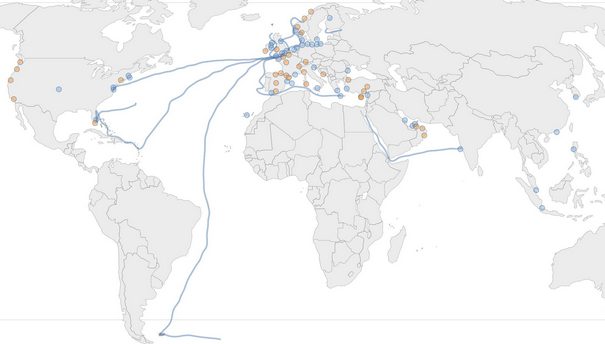
It was a bit of a blur. Blue is work on ships and shipyards or training others or being trained. Orange is personal or work prospecting. 310 plane flights and 40 in helicopters, quite a few tugs too. Very roughly 1 million km in cars/buses and trains. 1977 to 2006.

First ship; 1973; training vessel; age 13; crewmember, foremast topgallant (that means near the top at the front). A bit windy, what!

Last ship; 2004; Lars Maersk; Engineer; Sea Trials (means finishing the electronics before first voyage – well, I went along for four days).

Where and when, for who? Actually you. Ships are a service without judging whether the cargo is necessary. On the large tanker, my job was to service the radar at the top. Empty, the ship goes up, to about 60 metres. Often, when you’re finished you feel very well; calmed. Then, bottom right, testing a new radar (design office engineer). Radars are required for when you can’t see anything (much rain or snow). I was never longterm crew on these ships; it’s a selection from about two hundred; my work was to upgrade, diagnose or repair. The photo upper left is the odd one out; install simulators in a maritime college. Three weeks in Tondo , Manila : ) Fun, much.
Let’s see, what else was I up to (in terms work or study). . . . . . .
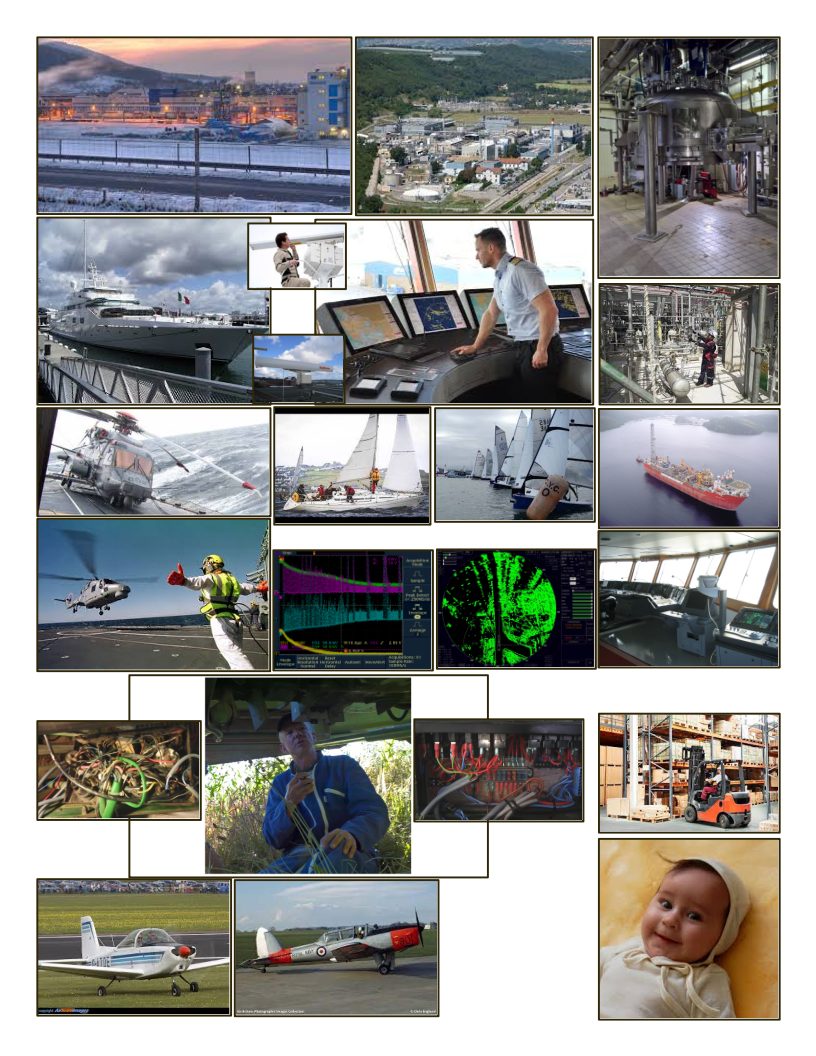
“This guys going to eat up all my mobile data for the month!”. I agree it’s a bit much.
Er, to the point. Kind men taught me to fly light aircraft (before I had a car license and before GPS was invented). Two years as a helicopter controller (mostly Lynx) was without incident thanks to great pilots. I worked briefly (in France) in the chemical industry, pharmaceutical processes on the sites shown. They specified, I wrote up the quotes; repaired and set to work a few. Only incident; I was poisoned once – it is a work hazard there. “Why a warehouse job?”. I was asked, actually asked to leave my career – to eventually do this here instead. It was very painful (the back injury too). “And why the baby?”. Our contribution was distributing textiles, including boxes of babies’ bonnets; I remember, placing however many were ordered. The printed delivery note shows a small shop near a beach; young mums have a chance to sort out a last minute purchase because it’s hot and sunny (dangerous) with a cold wind (takes a while to adapt). Hats off to everyone in what’s known as “logistics”.
I am actually in one picture, in blue overalls, diagnosing a combine harvester automatic levelling system (used on very steep hills). It was best to sort the wiring out first (before and after photos) – and provide drawings once it was done. Hard manual labour often, someone asked me to help empty several tens of tonnes of chicken manure (5000 eggs per day) which takes about five weeks (to pass the inspection, certain that all the machine automation is absolutely clean). It’s all very interesting.
“Meet anyone famous?”. Well, the motor yacht Katana belonged to Larry Ellision (although I didn’t meet him after installing a chart station with flat screens – flat panels were nearly unheard of). He’s CEO of Oracle – doesn’t mean I’m an IT whizzkid. I’m 60! (When I wrote this; now 65!).
“Yes; no photos; please use your imagination”. There’s three marine commandos and I in a rigid raider (a moderately fast boat) at night, pitch black. I’m 20, they probably are too. We’re floating about off the coast of Hong Kong waiting for the Triads (Chinese mafia), in the dark, lights out. Says one to me “So; you’re an Officer; got your own cabin on the ship?”. “Sometimes” I reply. “I’d die” he says. Silence. Another marine asks “What of?!”. “Masturbation” replies the first. . . . . . . . . . . . . . . . . . . If the Triads were near, they’d have heard us all laughing a mile off. So, at dawn we go to a beach (with the hovercraft escort) and I leave to spend a day with the Gurkhas. They’re working at night too, watching Chinese citizens crossing the border (for whatever reason). They pick them up, with greetings “Nice to see you again; third attempt. Well, you know the routine; back by bus; hot tea and sandwich over there. . . .”.
“Ever been injured?” Uh, two false alarms for Cancer with surgery to work it out. One hand jammed in a magazine (ammunition) hatch latch; the medic states the nails will all fall off; he offers me – now or later – I choose now; peeled off with pliers, no anaesthetic, back to work. You can see in the photo, the orange gloves leave plenty of room for bandages. “Then?” Cholera in Oman. I didn’t know what was happening (which is usual) and so sat it out without seeking treatment for I didn’t know what. “Surprising it didn’t kill you” says the doctor at the social evening. I was 32 so pulled through. Much more I’d prefer not to mention . . . .yet the only harm offered and done (in physical terms) was the young driver in Tarbes, France at 11 at night, speeding at 100 km/h in the town square. He was furious that avoiding me meant losing his race. He knocked me to the ground and didn’t beat me to death, because a very large dark fellow walked up behind him, without saying a word. The other ran off. “Then?”. Work accident, investigated (sort of); appalling lower back muscles injury; five weeks of nearly no sleep. “Then?”. On the way to a farm in winter, a small deer tries to jump out of the ditch and cross in front (they usually succeed, quite precisely). I’m on a scooter, well wrapped up. 32 minutes later (after total loss of recall) I see a face “Matthew. Are you alright?”. I don’t know! Broken right shoulder blade (it turns out). Then, more recently an infection (from a cat) of Bartonella, with resulting cyst. Surgery needed. So. To round off, this year, an agonising hernia of vertebrae L4/L5 and a slipped L1/L2. I forget the pain level (fortunately). All the muscles of the back (except one) went into atrophy during the four month hiatus. That was really very traumatic (one day of one hour, paralysis, unable to urinate, check phone number for the village nurse to insert a . . . . . .thingummy jig. . . . . with jug). This week I can walk, sit, sleep, cook, repair the car and . . .rebuild this website.
“Which reminds me of one last anecdote”.
Ah yes; athletics. What I do is commonly known as trouble-shooting diagnostics. Yet, often, someone’s already examined it before me, using all the right protocols and procedures – and also more talent. The peculiarity that (for some reason) my education can offer is what’s known as examination of “oversight”. You may have heard of Oversight Committees, those who study the lesson learnt after events that were all supposed to be already covered by regulations, observations, attention and talent. If things still fall through, the “oversight” study aims to find out – because it is, at that stage, obviously something you didn’t know nor think of. It’s discovery, in a way.
“Athletics?” Ah; yes, my experience is that there’s always someone better at something, including my mental processes. Watching the Olympic games it’s only wise to consider that we’re not necessarily seeing the fastest, strongest or most skilled. We’re watching those who’ve set aside the time and travel to participate. Ah; different thing! I may have seen a world record. In Ireland, after training software programmers about radar collision avoidance (Raytheon) I took the evening off with a stroll around the town’s medieval ramparts (which are not very high). On the inside, chic shops and coffee houses. The other side, armoured police in armoured cars discussing a dispute with neighbours. All very calm, twenty yards apart. I walk on and to my surprise see lads under the wall preparing small petrol bombs. Furthermore, that sunny evening, a stone flies just over my head; aimed not at me, rather at the barbed wire observation post with cameras. I’m just taking a stroll! It’s a beautiful evening. The police decide not to sort things out, rather preachers and social workers arrive. That doesn’t work either. Someone makes a call and an Opel Corsa arrives; two strange men get out. The youth below run – so fast that only their toes touch the ground – maybe. It’s difficult to be sure; the grassy slope goes far; they’re here, then suddenly in the distance. Artists attempt to illustrate such things using . . . . .figurative methods. . . .yet you really have to see it to believe it.
Summary – sort of
Please reflect as you choose, yet be careful about mariners. Nobody ever harmed me on a ship – not once. Yet, switching from Royal Navy to commercial shipping was a choice highly charged with deep thought. I was involved (before) with installing JOTS systems, passed secret codes on paper tape and spent weeks in front of safes and combination locks. Spent time in the bunkers of Northwood and Gibraltar too. The USS Vincennes incident appalled me; they didn’t know what to do with it and I didn’t know how to fix it. I fired myself. Many tried to get me to stay and yet, the military “oversight” was just too huge. Yet our paths kept crossing. After ten more years busy with commerce I was called by the aircraft carrier in the photo. They needed a repair of a commercial system of electronic charts they were trying out. I went back to my roots; in favour of collision avoidance, in favour of the crew safety and the crews of vessels they might hit, somewhere off the coast of Mallorca. Without mentioning that I was a former Lieutenant Commander in the Royal Navy, I just did the job and ate in the canteen with the technician. We are all watched over by a very determined woman carrying an automatic rifle. It’s a volunteer Navy too (the USN) but not the one that I knew. It all depends on where you come from; which is where I started.
I hope you get it; the colours of the different situations are as varied as the number of flags. It’s difficult to feel decent. It’s one thing to learn “patrol-and-send-a-message-if-you-see-something”; quite another thing to calculate how to harm someone else at a distance while attempting to make sure you’re not harmed yourself. That’s what it all has in common with “civilian life” while they (civilians) pay and you – well, maybe. So I left; completely appalled.
Personal records.
I’ve been nearly broke once and absolutely down to nothing twice (financially) notwithstanding several occupations on minimum wage and one at the peak of financial thanks for engineering well done. No sexual activity since 1986; Proposed marriage twice (including to an Iranian women who very gently declined). That may not mean much to some readers and seem inappropriate here. Please bear with me that it’s much more significant to certain cultures in places we’ve never been. Yet; overall; I recall Kim, Virginia Beach, 1981, her simplicity and sincerity and I might . . . .imagine our two melting into one. . .no longer able to. . . detect who was who. The story of my life, in a way, appears to have missed the boat.
Yet, were we involved as a team (she with I), no matter all other measures and emotions, Cancer would have reared it’s ugly head sooner or later. There’s much else going on (of course) so I adopt and adapt to – work that out now. Not only that, yet you, dear readers. . . . . . however you’ve continued. . . . . I hope you may consider that my service is in favour that you continue. With anything and everything you choose – but not that.
There’s nothing funny about being killed by a vegetable. Scientists may start screaming “It’s not a vegetable! – it’s a tuber! a starchy one – féculent in french!”. Well, alright, yet perhaps you might use your doctorate intellect to realise I’m addressing myself and my limitations – to someone else – than you.
“Er, well, that was tough. Um, what are you doing now?”
Hoping that someone, anyone will comment favourably on any of the pages of this site.
“And why?”
Because, as you know, my life was measured in terms – results. I apply that to myself, no matter the number of promises, no matter which level of presumption of competence and no matter who by.
“Oh my God: suggest I”. . . . . . .Unbelievable! Everything’s alright the way it is – including total communication failure. I really feel happy – realising it!
“We get your point”.
That I’m happy? “That too”.
How I do what I do now.
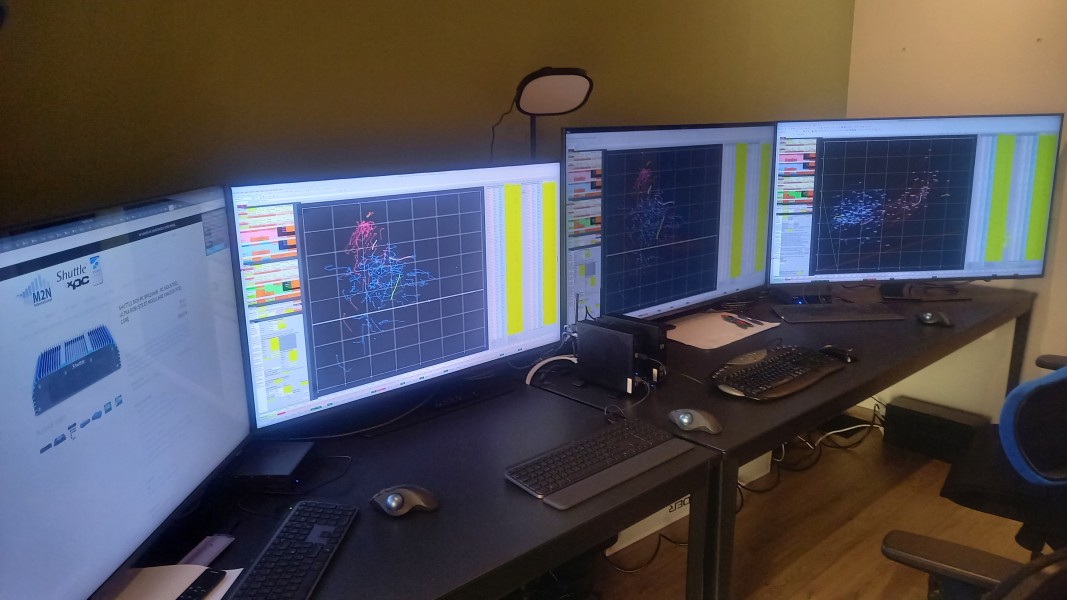
The data (huge) is calculated in the background. Analysis at any one computer requires two monitors (like engineering with two A1 drawings; it’s just common sense) while using the file later or doing reports requires only one. I choose a battery inverter and lightning surge protection to protect the work. I choose Shuttle equipment for silence; it’s also gear for 24/7 operation in hot or cold environments, top class. I wish my work was.
To bring the appalling truth to light, the handbook was/is Svante Arrhenius’s Immunochemistry lectures from 1907. I don’t wander around with models and regressions and probabilities. In many ways our metabolism behaves in energy transfers like for helicopters. There’s a source (the turbine) and what you do with the controls has to share it out. If the pilot hovers at maximum load – there’s nothing available for sideways, turning nor going any higher. Most of my work is in the energy domain. A competent chemist will point out that we usually read or hear about products, what’s left at the end of a reaction. Yet there is always a rate at which it happened; that interests some chemists because you’d better get that right too. If you’re in class watching a prof place one chemical in a bottle on the table – that’s, perhaps interesting. If the prof places two, even I know something’s going to happen. When the prof mentions he or she is going to mix them together – perhaps, like me, you suddenly wonder if you’re sitting a bit too close. He may say “Pay very close attention” and I’m thinking “I’d rather not”.
The pertinence about chemical reaction rates is when that’s the result required or hoped for – and not the product at all. Fireworks for example, or glow in the dark sticks, lamp bulbs, welding equipment and, of course, our vehicles. The introduction page remarks the fact of our bodies being rate devices – thinking only of a static skeleton or tissue simply isn’t good enough. “What” flows is important to know for treatments; you’d be surprised at how much work is done on “how fast”; just less is said about it. If you’re defending yourself against something or keeping a distance, it might not be just to avoid the reaction, rather more interested in the possible speed. Riding a scooter, one adversity (in the country) is the number and types of dogs who crouch and launch themselves, all teeth and noise, directly at you and your legs – because the movement is similar (from their point of view) to their prehistoric prey. I’m aware not to exaggerate the risks; colleagues in Africa might well suggest it’s far more an adrenalin rush when it’s a cat – as big and fast as they can be there. Yet, it seems big cats (like lions) work it out and concentrate on something else.
“So what!” “Do you suggest is your experience and qualification to do this instead?”
Readers may appreciate posing that question rather at Level 7. I share there how Peruvians worked it all out before in the 12th century (from a European chronological point of view, which, of course, doesn’t matter).
I watched Youtube last night, as every night before going to sleep, including Mark Rober showing how things are going for he and his son “The Truth About my Son”. While I’m a fan of Derek Paravicini and enjoy watching Jools Holland jump out of his seat after playing piano with Derek, Mark points out that supposing autistic children will amaze with some genius (that nobody else can do) . . . . .well, it’s supposition and rather misses the point. It’s the presence of someone that influences for the better where it matters most – at home.
Here I sit, using a keyboard in a way that is else than going to amaze you.
For many, the implications are going to be extraordinarily painful. My work has done that before, when in my twenties, where the hidden was made evident – by my work contribution. Project managers – floored. I think, not because of the facts presented, rather because they recognised that work (done like that) is without pretensions of being controversial nor conforming nor confronting nor campaigning. “So, what is it instead?”. Well, like quiet conversations with a colleague around a problem. A bit of banter later (perhaps), yet successful because. . . .there’s no bawling loudmouth nearby. Usually they avoid the critical situations my work covers. A client might remark, utterly shattered “Oh my god!”, have difficulty breathing yet manage to say thankyou or with a gest of one hand. Some in pain think to apologise, for things we didn’t even notice, yet they feel badly about.
I’m writing because someone asked me to. Else, not one word. “Because?”. I’ve learnt that most (not all) are only going to approve something because it’s specifically something they like. If they’re on the way to get what they want – they can put up with quite a lot of discomfort and stress. But not this. There’s nothing likeable here, neither about Cancer nor about what caused it, and not a drop “nice” about putting the matter straight.
Mark Rober expresses his own view that even if someone ever did/does resolve Cancer, it won’t compare well (if at all) with the love and balance provided by people such as his son. I agree, yet what can I do about it? Abandon, because this here is inferior (which it is) or deduce what it is that I’m missing? I calculate . . . . .that children. . . .including his son. . . . .were even happier. . . . .if Mark were.
Mark’s sincerity is striking and refreshing and reminds me of someone I knew. Mark and his invited guests label their effort as “fundraising”. So I consider the financing, because it’s pertinent according to him (not I); there’s something out of balance. Born to serve (once I got the hang of it) I do, of course, reflect upon the fact that I’m in the wrong century to live out altruism all day. Coupons, called money, are the way of the day to share out a view of recognition for services rendered with the notion that the recipient may distribute in any way he chooses. . . . .to similarly recognise the value of effort or material or both (preparations and pauses), done by someone else. More practical than an exchange of a sack of carrots (where I live); yet the same sack carried over mountains on the backs of animals who require hay and pasture with protection . . . .well, quite priceless. So Mark (if I understand partly) is suggesting financial support and recognition of services of love and laughter provided by . . . .those without money at all. In many societies that’s what Americans might call “a given”; it’s obvious. Yet, Mark’s mostly addressing himself (it seems) to even more Americans who might not yet have gotten the point.
I’ve learnt that Altruism or as-near-as-you-can-get is a risky way to live. At thirty years old my choice was to live and give away every penny before the end of the month, every month to any cause that asked; success was (according to my plan) nothing in the bank every fourth week. Quite an adrenalin rush. Paying contributions to the social security was also, according to the plan, one way to fund men and women and children I never met – because they were in difficulty and I’d also pay someone to watch over, watch out for them, those who make sure they make it. If, only if, I ever found myself in a family or adoption situation were I to think of settling more precisely in one place, saving to invest and still with nothing or not much left over for me. Seemed to work.
It’s very, um, motivating, to be persistently poor – until something goes awry.
When on the way to the farm in winter 2017, after the collision with the deer (age 57), I couldn’t work due to the broken shoulder. Nobody chatted before to me about health insurance in France; very different to the UK or Germany. You contribute monthly, but the state then only helps out with just over half the costs once you’re injured. Well, without surgery needed I could just about cover it and collapse at the house. I then found out that – because I hadn’t done a hundred hours hard labour in the previous month – and because the fact that I was on the way to do far more didn’t count – there’d be no financial support at all. Zero. Contributions paid from age 17 to 57 and then. . . . .the only occasion I was seriously injured; no help at all.
I’d been peddling hard, but no pause allowed (that’s the rules). Well; the vehicle insurers called up and said “Doesn’t matter; you chose full coverage, which is very prudent. Since ten years the government compels insurers to set aside funds for – let’s see now, victims of bombs, terrorist attacks . . .and collisions with animals. Things insurers used to get away with ignoring; so you’re good”.
Sort of. The huge impact of only a very few insurance thieves is that the FGAO uses the employer’s say-so as the validation that the pay bulletins are real and not a Photoshop fraud. The young woman who coordinated my work (at the agency) put the phone down and refused to respond. She’d lift a finger for someone in the Office at the European norms of air-conditionning, but hadn’t a clue how to handle the bread-winners “out there” in -8 to +38°C. She said “I don’t know; I don’t know. . . .” then stone-walled. I wrote letters and didn’t understand it. In all my previous work – we’d be thrilled if someone was punctual, performant and prudent. Not she. Nothing yet again. One might well ask, what is my private vehicle insurance (fully paid up) , also since 40 years – got to do with her anyway? Quite her point of view. The point is that small insurance fraud and petty crime – puts everyone else’s backs-to-the-wall about proving their genuine distress when they’re just attempting to get back up and get things done.
So; my situation collapsed; my health got better, yet the confidence was ripped out of me. A very kind woman from the Social Services (in the City) telephoned by surprise and asked if she might come round because someone confined due to his injuries was entitled to one free session at home; she had a proposition. Although unemployment benefit isn’t intended to repair errors of judgement by others, might I consider their help, in that way, until something new worked out? She watched and said softly “I meet men like you . . . . and they always decline”. Darn right! I still had two hundred euros and I wasn’t dying!
But then I found out – that I couldn’t do this work for you either. It needed a trackball and second monitor and new computer and more memory and . . . . .real food to heal properly. The vehicle insurers did, in fact, help by organising a doctor’s review and he had “authority” to add money for . . . . .the scars and what was it? . . . .”inconvenience caused”. Like I was a male model who’d never walk the catwalk again. So I said alright. Money for “inconvenience”. I don’t think I’ll ever understand that. Neither, perhaps, will Mark and his friends. Bizarre? It is? Enough? Nope. So, ten months after she (the kind woman) asked, I contacted her office (because she asked) and my attitude changed. 16 euros per day, from the mutual insurance of agricultural workers (where I’d input the least amount) for three years. Now, today, I’m BNC, PRR in the MSA receiving pension funds from the MOD of the UK (and understand it!). 14 years in the Navy merits that (apparently) so I’m no longer on the social security payments. The Brexit papers are done, private health insurance too. Yet now I’ve to write up Diabetes and Cancer with all spreadsheets; clarify one thousand Health Authorities and ten thousand scientific departments; complete the website in seven levels and twelve languages. . . . . . . . .Yet I stop writing here . . . . . . .for a moment.
Dear readers, please refrain from telling me (or anyone else) what they should or should not do.
I ask. I’m capable of . . . .much; but not leaving this (offering an end to Cancer and Diabetes).
So I hope Mark (and men like him) might agree that if I help him (without money, using free software and shared data) maybe I’m helping his son too – perhaps in a way that his son will detect and appreciate – just the way he is. Yet that is, of course, according to him. And even more significant; we (none of us) know how it will feel. Some have attempted to joke with me that they’re vexed “Resolve Cancer? Now what am I going to die of instead?! I was counting on it!”. Covered by insurance, convinced of Cancer and every square metre covered by nuclear weapons. . . . . . . I can understand that sometimes, it occurs to people that, perhaps they’ve had enough. Any way out that seems legitimate.
Neither Mark nor I nor his son can state for a fact how we’d feel in a world with neither nuclear weapons nor Cancer. I do, of course, defer to him. They may choose to have a go – to attempt to estimate how they’d feel. Those menaces are like cages of influence and pressure (to me) – because they wipe the smiles off many faces of those we meet – even when we suppose we feel actually happy today. This is awkward to express, so please bear with me as I stumble once. There is, of course, I learn, a huge load carried by the developing countries, still not paid fair wages . . . . because some of their clients in the first world are paying more instead, to have more, including Cancer treatments. The load, the expense, the unhappiness – and always the financial stress and ruin passed on. . . . .to someone else. I hope Mark feels well about my attempt at a summary, noticing (as I do) that his video is labelled as related to finance and funding. There’d be a lot more wealth if Cancer were cancelled and Diabetes done with. Experienced colleagues could stick around rather than die off. Now my writing is off-topic, mentioning prospects. If your nation does prosper like never since a century – please consider asking your public servants to refund the huge taxation rather than quadruple the spending on weapons. I’m unable to please the selfish with what they want now or next, but I can ask them to defer about this, just for once.
End of Epic
Offline chat. [ I think I’ve done alright; without a word of what anyone should or should not do; a few askings; pleading not; what do you think? “Quite good in fact!”. Oh; I was expecting less, um, enthusiasm. Er; it occurred to me to make an effort about the University of Cambridge and the Royal Navy. What do you think? “Please do!”. Oh; okay. . .]
One measure of something, written on an “About” page of a website is, “What our clients and collaborators say about us”. I think that helps. “Finally on topic!”
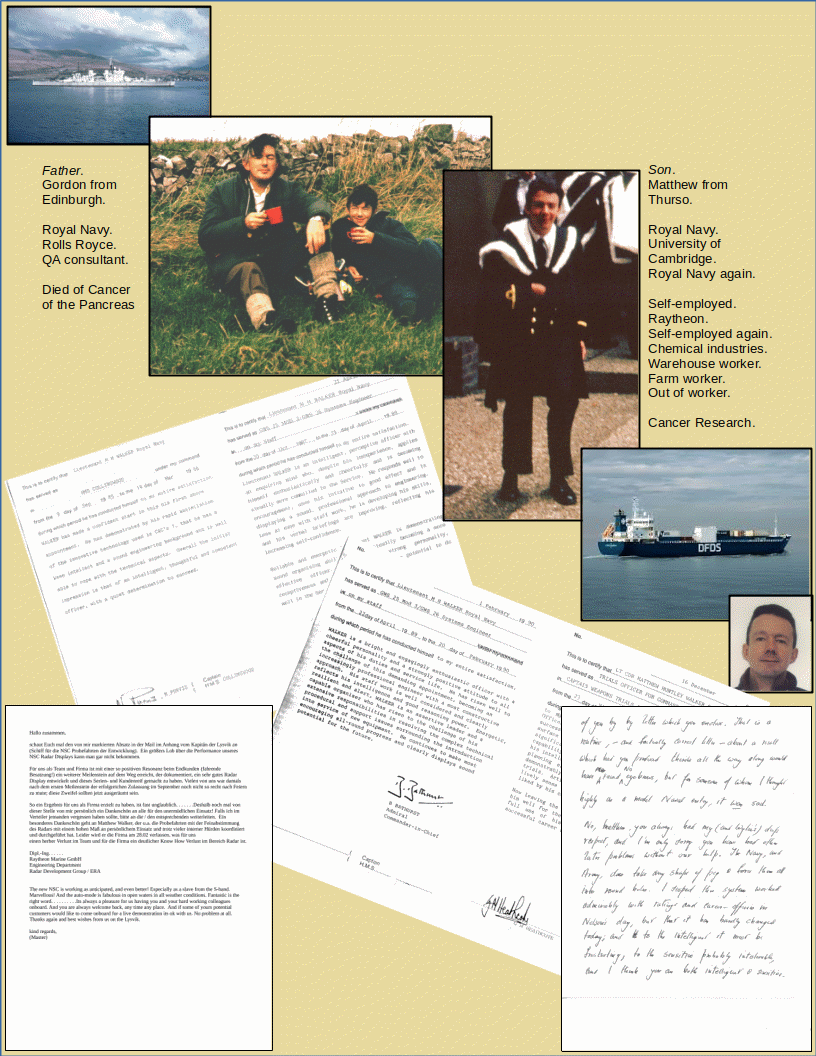
What the papers had to say. On the record and Off the record.
1989. Lieutenant WALKER is an intelligent, perceptive officer with an enquiring mind who, despite his inexperience, applies himself enthusiastically and cheerfully and is becoming steadily more committed to the Service. He responds well to encouragement, uses his initiative to good effect and is displaying a sound, professional approach to engineering. Less at ease with staff work, he is developing his skills, and his verbal briefings are improving, reflecting his increasing self-confidence. Reliable and energetic Lieutenant WALKER is demonstrating sound organising ability and is steadily becoming a more effective officer. With his strong personality, receptiveness and adaptability he has the potential to do well in the Service. (by Admiral).
Well; that’s nice. However, it means also. . . . WALKER is inexperienced (so we’ll forgive him much), his staff work is unmentionable, he’s got a loooonnng way to go before being effective at briefing others. We notice improvements (thank god).
1990. WALKER is a bright and engagingly enthusiastic officer with a cheerful personality and a strongly positive attitude to all aspects of his duties and service life. He has risen well to the challenge of this demanding appointment, becoming an increasingly professional engineer with a most constructive approach. His staff work is well considered and clearly reflects his intelligence and good reasoning power. Energetic, resilient and alert, (he) is an assertive leader and a capable organiser who has risen to the challenge of his extensive responsabilities in resolving the complex technical procedural and support issues surrounding the introduction into service of new equipment. He continues to make most encouraging all-round progress and clearly displays sound potential for the future. (by Admiral).
That’s generous. In the detail of what was going on my engineering work was to notice “oversight”; what wasn’t working, describe why not and be ordinarily steady when others went very pale or red with rage. Cheerful? Not really; rather I was also calculating about personal (very deep) unhappiness and applying the same attitude about it. Why and why not – about much.
1991. Lieutenant Commander WALKER has conducted himself to my entire satisfaction. Very competent as a Trials Officer and Section Leader (he) has successfully conducted trials of the Royal Navy’s newest surface ship command system. . . . . .Rigorous, yet pragmatic in his approach, he uses his intellect and good engineering knowledge to great effect, planning effectively his and his team’s work, and he is demonstrably capable of orchestrating complex and protracted trials. Articulate and persuasive in debate and possessing a lively sense of humour, (he) is well-liked by his colleagues and is enjoyable company. Now leaving the Royal Navy early, at his own request, I wish him well for the future. I am confident that he will make full use of his many good qualities, and carve out a successful career for himself. (by Captain).
Well; that’s very polite. First time anyone noticed this “new” feature about WALKER; “well-liked” and “enjoyable company”. That’s what counts (I hope you agree). On the other hand, the idea of leaving the Navy early rather than aged 55 was to render service to others. Careering around sometimes; no self-control; unable to say no to anyone about anything; career intentions – none at all. Eventually it might work out (takes a long while to adapt, modify and contribute in commercial endeavours strictly governed by regulations). Can it be done? “Done”.
1994. So I do small boat repairs and installation; meeting so many very decent gentlemen and women, who, at the same time are ready or prepared to face challenges; right in the face – anywhere, as long as it’s difficult. I suspected that being in commerce was going to be with constant action rather than rehearsals – yet, actually, training goes on everywhere. While learning about extremely sophisticated navigation equipment with all sorts of situations (used by all sorts of people), I was reflecting much on how things were going, or going to work out (personal thoughts). Some would call it driving or flying “by-the-seat-of-your-pants”. In my memory are only thanks, simply done, kindly put. It was funniest when I was working alone on cables in a cabin roof; it’s called “difficult access”. A heavy dusty package fell on my head, all sealed up and full of dollars. The grandpa’s stash. . . . .hidden away and forgotten. His grandson was amazed and happy. Invited me along on the first cruise to Scotland. The point is that I was on the first steps to refreshing my views about “people” and accepting penury in exchange for experience.
1994. I felt to write to my former supervisor at the University of Cambridge who’d written a formal letter expressing his dismay thirteen years before (in 1981). He took risks by taking on Navy Officers directly to Cambridge and was (quietly) over the moon that my first year result across all eleven subjects of the engineering tripos was (what’s known as) a 2.1 (and he divulged that it was highest, only just outside the first class degree group). Quite a start. I recall no feelings of any particular pressure (and none at all from him). The studies were interesting, well put, well taught and it was just natural to continue – because it was interesting; no other reason. Yet from his (Dudley’s) point of view, it was quite a bonus if his selection instincts were vindicated, by measures of results of some kind. Kind he was; extremely so. So, he wrote (in 1981) that my fall to bottom of the class in the final year was appalling and sad. He’s also careful to mention that third class every year for three years were quite acceptable (would raise no eyebrows). You’ve already shown ability by arriving at Cambridge at all. Yet a meteoric drop was (for him) quite appalling. I wrote back in 1994 to explain that I’d worked out what did it – the why. No expectation of any response. He’s a busy man who remembers everyone across decades. In the hand-written letter he expresses himself as hugely relieved to have an explanation. I’ll attempt a metaphor (for you dear readers).
On a long haul flight over the oceans or Greenland, if one of the four engines catches fire, breaks apart and breaks off (it happens, Rolls Royce or not) you won’t see the pilots looking out of the window saying “Ha! Ha! Glad it’s gone!”. Huge effort is applied to recover the situation (onboard) and record it. Then ships and divers are mobilised to find the pieces, the evidence, to learn the lesson – with much methodical behaviour, safety measures, time and danger. Young students may not impress every day, yet if they fall by the way, it’s best to consider their value. They progressed to further study (without pay) which says much. What about all the teachers and family involved before? Recovery is important – if you attribute any value at all about human life (it’s rather more significant than one gas turbine) – whether they’re going to assume responsibilities in future, or none at all. There’s been a lot of investment and well, I’m interested in what caused someone to stagger or worse. Not everyone is (interested); not everyone thinks like that. “Dog eat dog!” they suggest. Are you quite sure? Or is that a large indication about how you behave as a result of your choices?
Well; that wasn’t very nice. Yet, here I’m attempting to help, comparing three year olds with brain tumours to – some with the characters of “wilting violets”, suffering not much worse than a jolt to their finer feelings. So it comes out firm in your favour.
[Unfortunately, the memory resurfaces of a University Professor of Physics and Mathematics watching me settle in (age 45) and remarking “He looks like he thinks he knows something!”, while smirking and sniggering. For what purpose? To cause teenage girls in the same room to snigger with him! I feel, dear readers, not to worry that engineers “know something”. Worry about flying (that it’s going to be a flight with a fright or worse)? If engineers know nothing, such a type of aeroplane won’t be able to take off. There are prototypes of course and final configuration test flights, yet if you’re buying a regular ticket for an inspected aircraft, that pilots approve, it’s because everyone involved. . . . . .knows something.].
“So. To resume. . . .” Where were we . . . . .
1994. Dudley (Engineer) responds (from Cambridge) . . . that he’s going to burn my letter (about the assault; if you’re hit by a bus, that doesn’t mean you’re unbelievably weak; no more about that); then Dudley resumes his kind feelings and how he wishes I could be with him there (in Cambridge) for a while. Had I reported a problem, he probably would jump straight to the point – how can he help now, where he is (even though steadily going blind). In that particular case, I’d concluded an enigma, worked it out already. . . . . .so he was in favour of a stroll, some fun perhaps and dinner together in St Catharine’s College. What a gentleman (and also, once upon a time, a prisoner of Japanese troops during World War 2). The company I keep is very varied. He writes . . . .
You always had my (and Wylie’s) deep respect, and I’m only sorry you have had other later problems without our help. . . . . . .; and to the intelligent it must be frustrating, to the sensitive probably intolerable and I think you are both intelligent and sensitive.
Well, Wylie was a professor and two of us stayed on the summer, after finals (at University then at home then more) to help him complete a satellite navigation algorithm. I had the above letters since thirty years and now I read them again. I don’t have a copy of my letter to Dudley, everything on paper using pen and ink. When I think about it now, I pay more attention to him. When a former prisoner of World War 2 suggests that the situation must have been “intolerable”, that says much.
“How did it all work out?”
2004. A notable success (while in a team) was pointed out by a ship captain; I translate the preface from German to English. In general, we’re too busy to talk about things going well. In the world of shipping, navigation equipment is viewed all day – to check it’s still working correctly. Ship’s Officers neither have the time nor the inclination to praise anything at all; it’s “no news is good news”. They also keep a margin (no comment) to be able to forthrightly criticise faults later. It is, after all, safety equipment, nothing to do with liking or pleasing anyone. However my workshop and work-ship for concluding a new unique radar project. . . . .attracted attention. The idea was to share a working ship bridge, test the new apparatus side by side (done by British and German Engineers) and leave the extra new radar onboard (as a thankyou). Weeks later, coming back to the office was this (from the Captain) . . . . .
The new (radar) is working as anticipated, and even better! Especially as a slave from the S-band. Marvellous! And the auto-mode is fabulous in open waters in all weather conditions. Fantastic is the right word. . . . . . . . . .Its always a pleasure for us having you and your hard working colleagues onboard. And you are always welcome back, any time any place. And if some of yours potential customers would like to come onboard for a live demonstration its ok with us. No problem at all. Thanks again and best wishes from us on the (ship). kind regards, (Master)
It’s to be born in mind that the vessel was near brand new, perhaps the most challenged ship in the North Sea at the time with a very tight schedule, often atrocious weather conditions, fetching materials from Norway and highly automated to be able to do it at all; all year round, day or night. The Norwegian Officers and international crew were the best of the very best (in terms talent, experience and scrutiny). Not given to faint praise, perhaps none at all. It’s more my style; the device does it, or it doesn’t. I’d never seen anything like that message and learnt it had an effect on my colleagues. They’d been feeling anxious; a design office is very different from a tempest. They knew I’d selected a severe test situation (to make absolutely sure) rather than the less challenging options. Fifteen engineers (of all specialities) nearly hit the roof with joy. Of course, the internal message shared in print was more. . . . .um, reserved, focussed. . . .with intent. The point is that unsolicited genuine felicitations are priceless. I don’t mean loudmouths shouting “Rah! Rah! Rah! You can do it!” (while making sure they don’t).
Good morning everyone (from the Leader of the Radar Development Group in the factory). Take a look at the attached email from the Master of (Ship), the vessel chosen for the research and development department’s sea trials. It is simply not possible to obtain a greater affidavit about the performance of our (new) radar equipment. For our team and our company, this positive (and voluntary, unsolicited) enthusiasm marks a milestone; confirmed in writing that the product is very good indeed, developed not only for production yet already proven. Many of us (even after the successful government type approvals) were really not ready to celebrate; this (grave) doubt/caution can now be dispensed with.
It is barely believable for us (our company) to have accomplished this. . . . .I can only (yet again), from my post, send you my personal thanks for the tireless teamwork. If you notice the addresses are missing someone, please forward. A particular thankyou goes to Matthew Walker, who undertook the seatrials and fine tuning with a high measure of personal commitment; moreover (he) co-ordinated and led many teams (on this site too) to get through. Unfortunately he will leave the company (Raytheon Marine), which is, for us, a bitter loss to our team (and our company); the loss of such thorough know-how in Radar matters.
In review, I feel only so-so about my abilities in electronics. I was more competent in Navigation which helps a lot when you’re working with with ships’ captains. You’re technical, yet it’s a very agreeable surprise (to them) that you learnt the major part of their profession too (charts and autopilots). I smile when I think of my colleagues (British, German and Mexican), smiling. It seems life’s like that, consulting memory too; it still works!
Now I’m still (quiet), the data and analysis about Diabetes is in the works.
Seems impossible to present; yet I managed to do it before;. . . . . . .according to someone else. It seems that, in rendering service (my small part of it all), I’ve made “it” (in professional terms). . . . . . .according to others. It’s the service aspect that is mutual and recognisable to us; those that I met who provoked respect in me. The cooks, drivers, mechanics, technicians, hotel staff, pilots, surgeons, doctors, nurses, builders (I’ve done demolition site work too), roofers, farm labourers; we’re all doing service even if some onlookers think we’re behaving like slaves. I feel welded to what it all meant and breathe easily at my desk here (well now anyway; not aaaall the time!).
I miss them all very much. I hope my Royal Navy fellows will be, um, at least warily content. The point of all this page is to make sure that readers have an opportunity to consider the character applied. The reports are on Researchgate; completely impersonal and that, sometimes, well often, is really annoying. It’s the protocol, yet now you have more, to choose yourself.
“So what’s missing?”
Well, I’ve omitted any mention of mental anguish about anything in private life; concentrating on what (I estimate) might be interesting for readers of the reports. I’ve met many technicians and engineers more apt than I. We find ourselves specialising because my generation learnt during the greatest transition in engineering ever seen. Log tables and sliderules (I’ve still got mine) followed by transistors and computers (assembler, machine code, Fortran IV) and capable of being precise in at least four units of measure, decimal or any other. Then onto computers for anyone and almost everyone (with a phone). We’re anchored still, by quiet types with peaceful gaze, after suffering much, yet neither software bugs nor spam.
How to do the analyses placed on Researchgate.
I was a training officer three times (twice for Raytheon) and deduce that it’s quite practical to teach second year university students and they could do the analyses. They might well find out a lot more while they’re at it. Physical Chemistry background useful, not essential. The point of the (very different) “About” page above is that senior readers (from any walk of life) know, for a fact, that character counts. Anyone can learn something new, no need to make a song and dance about it. Applying it in an appropriate manner? I offer my experience of at least two ways. When young I could do it by being observant, naive, zero hostility and utterly convinced everyone were to be content to know. When somewhat older I could do it by being observant, well-informed, zero hostility and still utterly convinced everyone was going to be content to know.
Apparently not everyone is. I noticed that many gracefully accept the conclusions of investigations, even when those findings are unexpected difficult news. No smiles yet they get on with it. One does notice that it’s time to pack up your things and leave. Industry can obtain such short-term service without flinching – from those known as Consultants. I don’t mean peddlers of philosophies and business models; I mean doers who’ve done it on your own site with your own information already, with a result you can use. There’s a period of suspense, just like for any result. It’s normal that participants hope to see that suspense ended, the tensions eased and so you (the consultant) leave contact details and leave (to give them room). Back to your own room, at home or hotel and sometimes (well often) there’s a delay in transport, so time to look around and learn something else. . . . . . .about people.
Nationalities worked with for more than three weeks at a time.
Dutch, French, Indian, German, Danish, Singaporean, Hong Kong, Philippine, Estonian, Norwegian, Swedish, North American, Mexican, British, Belgian, Japanese, Korean (South), Italian, Spanish, Greek, Cypriot, Polish, Irish (Northern), New Zealand
Nationalities worked with for three weeks or less at a time.
Finnish, Egyptian, Israeli, Russian, Chinese, Bahraini, Turkish, Icelandic, Irish
Nationalities and their professions, near to or lived with for one to seven years (colocation, house sharing). German (Graphic designer, Male Nurse. . . .became Surgeon, Archaeologist, Student), Chinese (PhD economics), Cameroonian (Students of agronomy and information technology), Dutch (dancer), Luxembourgian (bartender), British (three nurses, one former Navy Officer, one software programmer, one businessman), Irish (diver), French (family), North American/French (family).
“Finished?” I think so, if it is so, according to the readers.
Anonymous comments are enabled. Name, email and so forth are quite optional here. Although WordPress filters out most spam, I do the rest of that work myself by hand. So your comment may be waiting for my return to this desk before appearing online. If you change your mind, wish to change the comment, prefer it be removed or moved to another thread, I can do that (by hand) yet (in that case) only if you contact me by email. Best regards! Matthew.